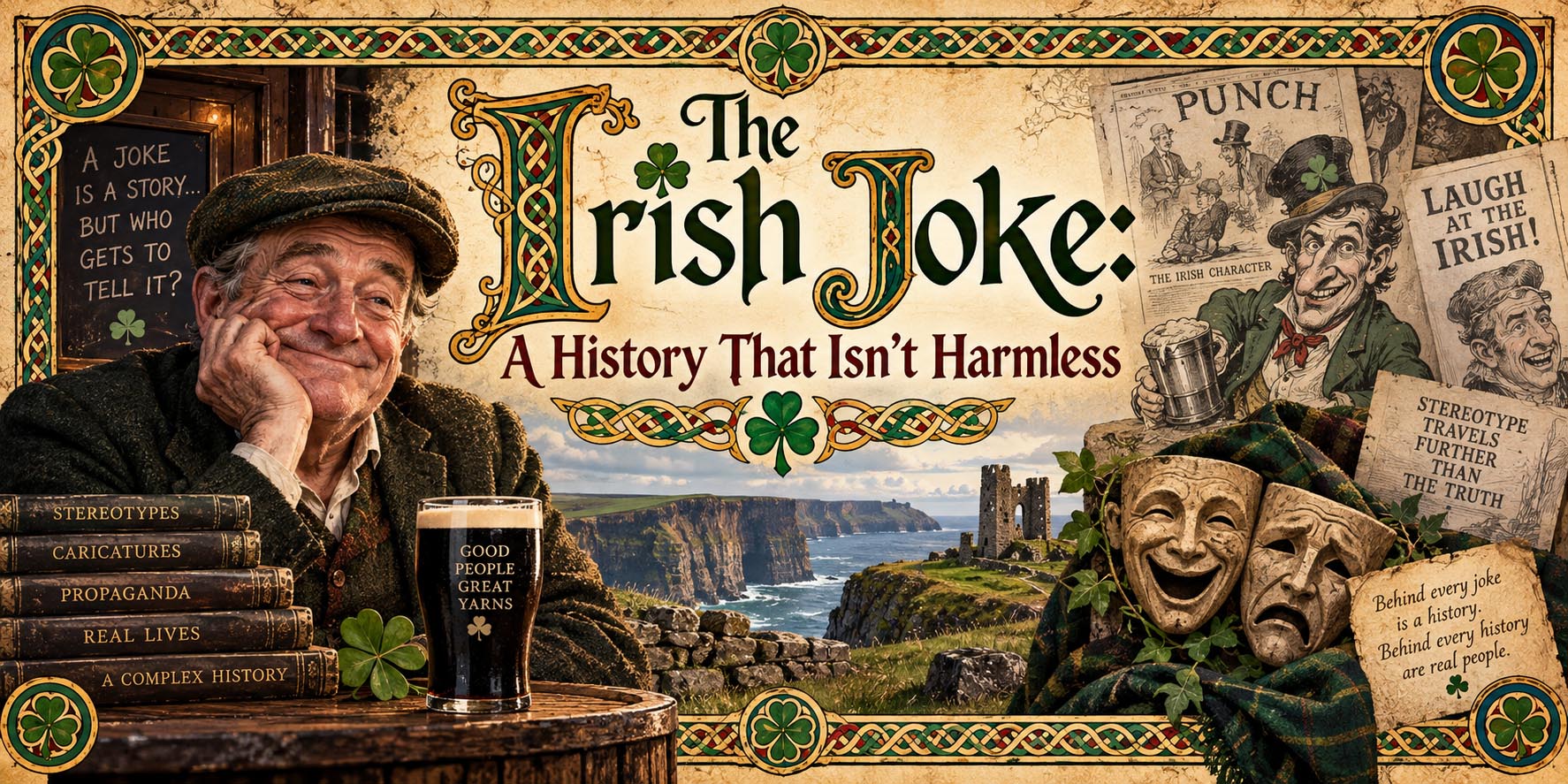
The Irish Joke: A History That Isn’t Harmless
A Humour with a Dark Origin
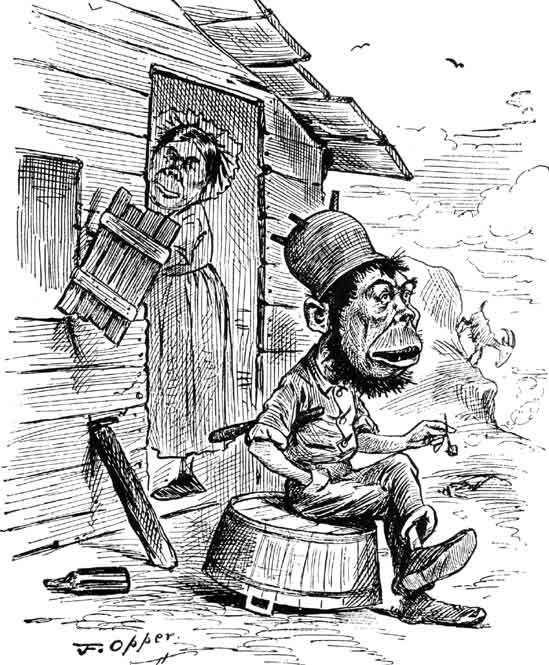
The so‑called Irish joke, often dismissed as harmless fun, has roots in 19th‑century anti‑Irish sentiment. In Victorian Britain and America, these jokes were crafted to portray the Irish as subhuman, violent, or stupid — stereotypes used to justify oppression and diminish growing Irish political influence.
These caricatures were not accidental. They were tools designed to render the Irish “inferior.”
How the Stereotype Was Manufactured

English Contempt and the Protestant Ascendancy
The “Irish joke” grew from English disdain toward Irish Catholics during the Protestant Ascendancy. It intensified when Irish labourers, especially canal “navvies”, arrived in Britain in large numbers.
Caricatures in Victorian Media
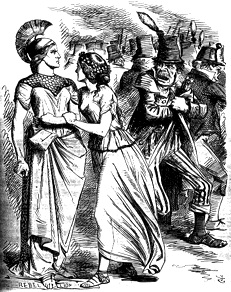
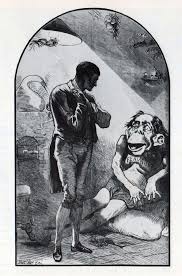
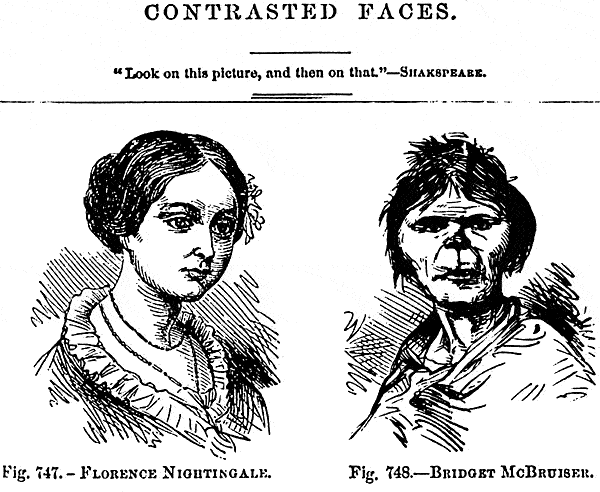
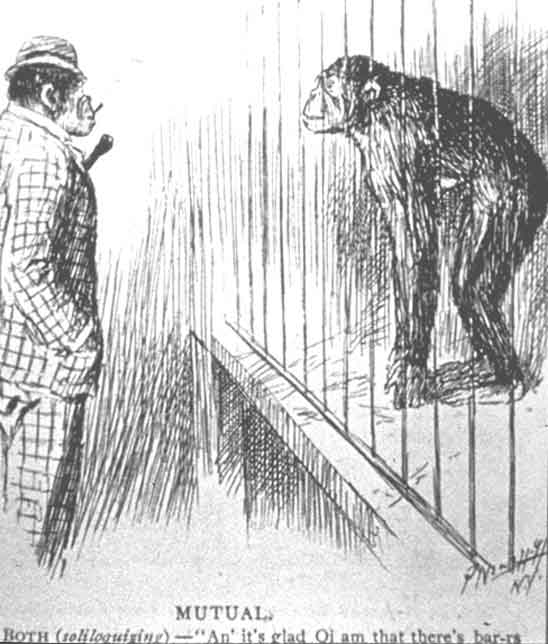
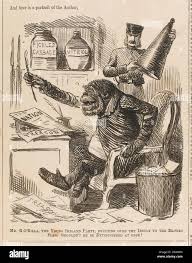
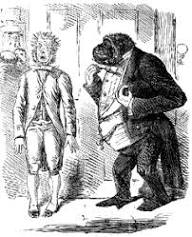
Publications like Punch popularized racist cartoons depicting the Irish as ape‑like creatures. These images were not humour — they were propaganda. This “Apes and Angels” style of caricature aimed to show the Irish as less than human, legitimizing discrimination and violence.
“Those who can make you believe absurdities can make you commit atrocities.” — Voltaire
Humour as a Weapon
As Sigmund Freud observed, humour can be used to shut down compassion.
It creates an “economy of pity,” where those being laughed at are deemed unworthy of empathy.
Irish jokes functioned exactly this way, making the dehumanization of the Irish seem amusing.
The Dark Origins of the “Irish Joke”
“Humour can be a way of shutting down pity.” — Sigmund Freud
Freud’s insight explains why these jokes were so effective: they made cruelty feel entertaining.
The Stereotype
“Paddy” was portrayed as:
- too stupid to govern himself
- too lazy to farm anything but potatoes
- too unreliable to trust
- too drunk to be respectable
These stereotypes justified British inaction during the Great Hunger.
If the Irish were starving, it was said, it was their own fault.
Up to two million died of starvation and up to two million left the country.

Across the Atlantic: Stereotypes in America
Irish immigrants fleeing famine found that old prejudices had crossed the ocean.
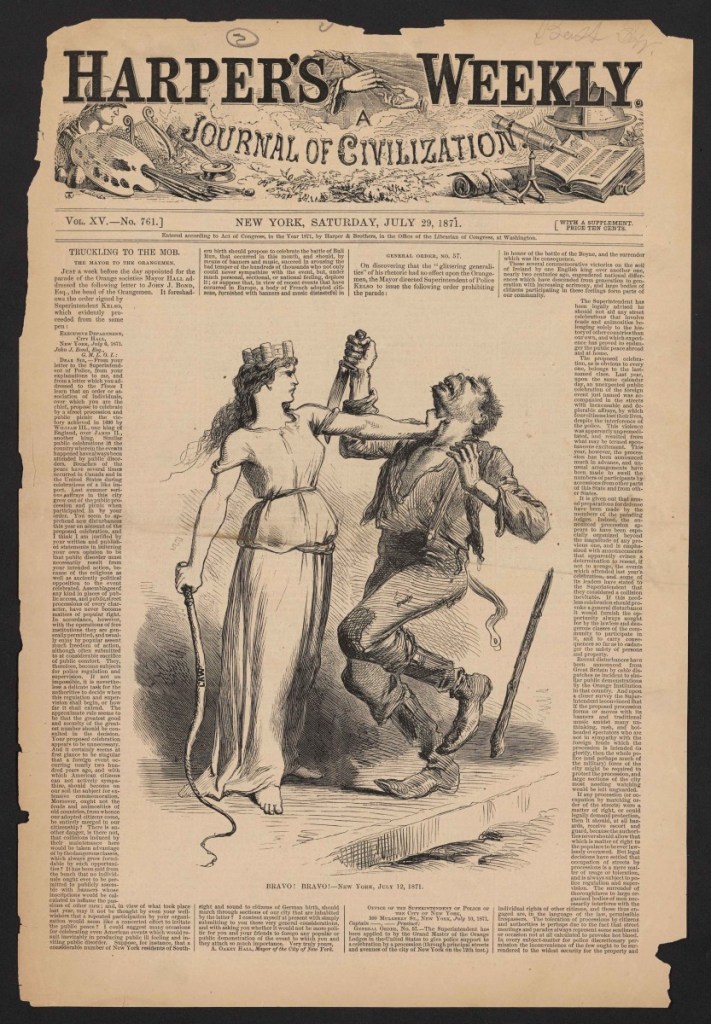
Victorian racial theories placed the Irish as “less evolved.”
Cartoonist Thomas Nast depicted them as ape‑like creatures.
Even Irish service in the American Civil War did not erase suspicions about Catholic loyalty.
The most persistent stereotype — the drunken Irishman — survives to this day.
Stereotypes, Politics, and the Persistence of Prejudice
Each spring, St. Patrick’s Day merchandise drenched in stereotypes reappears—“Irish Today, Hungover Tomorrow,” “Drunk O’Meter,” and similar slogans. These tropes echo centuries of deliberate dehumanisation.
Even in modern politics, Irish stereotypes persist. A former Australian PM and then opposition leader once joked:
“This government’s (Gavment’s as he pronounced it) like the Irishman who lost ten pounds on the Grand National and twenty on the replay.”
Tony Abbott made the “Irishman who lost 10 pounds betting on the Grand National” joke in June 2011, while he was leader of the opposition.
It is unimaginable that a senior politician would publicly make such a joke about Jewish or First Nations people. Yet Irish stereotypes remain socially acceptable.
The one word in the jokes that is omitted but implied is ‘stupid’. As in: Why was the (stupid) Irishman on the roof? Because he was told that drinks were on the house.
‘Stupid’ is always implied before ‘Irishman’. But it is omitted because it is felt that it is unnecessary. ‘Irishman’ is enough. It is self-explanatory.
When our erstwhile anglophile ex-prime minister told his Irish joke to his eager sycophantic guffawing colleagues, he fully understood that there was a silent ‘stupid’ inexorably intertwined in the word ‘Irishman’.
Funny and harmless? Or toxic and offensive? Or maybe just ill-judged and antediluvian? It certainly seems out of place and anomalous. It led to calls for an apology from the Irish Embassy in Canberra.
This was part of a series of incidents where Abbott was perceived to be making offensive or “patronising” remarks, including later St Patrick’s Day messages in 2014 and 2015 that focused on drinking Guinness adding that in founding Australia the English made the laws the Scots made the money and the Irish made the songs.
It would be hard to imagine a senior politician in America or UK playing around with ethnic jokes.

It was so bad during the 80s that Joseph Small the Irish Ambassadors to Australia had to intervene with the Australian government to try to curb the tsunami of insulting jokes on radio and television.
Even now when I tell friends that I was highly offended by the derogatory Irish so-called jokes of the 80s and 90s they argue with me and tell me I wasn’t. I just misunderstood everything.
It’s hard to reason yourself out of something you didn’t reason yourself into.
People were bringing me lists of Irish jokes. The ten best the hundred best as if it was their duty to insult me.
I was a captive and easy target, as I was running a squash centre and I was at the counter when it was busy. Everyone felt it was their duty to insult my heritage with impunity having collected all the racist jokes from around the world and made them into an Irish list. They didn’t think it was personal but it was. Insulting someone is always personal.
A friend of mine, Mark that I played music with was in charge of a large building site. A young man on his first day of employment opened with an Irish joke. Mark cut him short and said ‘if you start one more Irish joke, you are straight out of here’. That’s how incensed we all were.
It is always easier to justify genocide or race murder if the race being exterminated can be shown to be primitive, crude and simple. The British were masters at that.
The attitude adopted by the exterminators towards those whom they were exterminating, is revealed to us when we know that the former greedily accepted the most wildly grotesque stories of the latter. In Nash’s edition of the Hubidras, it was solemnly stated that when seven hundred Irish had been put to the sword by Inchiquin a controversial 17th-century Irish nobleman and soldier known as “Murrough of the Burnings”. ‘Among them were found, when stripped, some that had tails nearly a quarter of a yard long. Forty soldiers, eyewitnesses, testified the same in their oaths.’
It is not surprising that forty soldiers would testify under oath when they were threatened with having their tongues removed if they refused.
Devils have tails so the Irish were devils and should be slaughtered to appease their protestant god. Or they could be little pigs.
A Protestant minister with the troops in Munster wrote home to London that when they had stormed a certain castle, many of the slain defenders were found to have tails several inches long!
(These were more Irish devils to be slaughtered in the name of God the Just.)
These can be viewed as forerunners to the Irish jokes although severely lacking in mirth.
A Personal Story
During the height of Irish jokes in Australia, a young teacher told the author’s wife she didn’t believe an Irishman could be intelligent enough to write a book. Her entire “knowledge” of Ireland came from jokes.
This, despite Ireland’s extraordinary literary heritage:
- W.B. Yeats
- James Joyce
- Oscar Wilde
- Samuel Beckett
- Seamus Heaney
And of course, the Book of Kells, one of the world’s greatest cultural treasures.

Colonising the Irish Mind
Since Strongbow’s invasion in 1170, English policy sought not only to occupy Irish land but to colonise the Irish mind.
The Statutes of Kilkenny
Banned Irish language, customs, dress, and sports.

The Penal Laws
Designed to destroy Irish Catholicism and bar education. Edmund Burke described them as:
“A machine of wise and elaborate contrivance… for the oppression and degradation of a people.”

Free Speech, Myth, and the Limits of Humour
“The great enemy of truth is very often not the lie, but the myth.” — John F. Kennedy
JFK warned that societies cling to inherited clichés, filtering facts through prefabricated interpretations. This is how stereotypes survive.
What Free Speech Actually Means
“Freedom of speech” originally meant the right to criticise government without being executed for treason. It was never intended as a licence to humiliate others.
Article 19 of the UDHR affirms freedom of expression, but the ICCPR clarifies that this freedom carries duties and responsibilities, including respect for:
- the rights and reputation of others
- public order
- public morals
Modern societies recognise limits: libel, slander, incitement, hate speech, privacy violations, and more.
“The smart way to keep people passive is to limit the spectrum of acceptable opinion.” — Noam Chomsky
Those who shout loudest about “free speech” often mean something else entirely: the freedom to incite bigotry without consequence.

The Difference between Derogatory Jokes and True Irish Humour
It would be remiss to end this page without acknowledging something essential:
Irish humour is not the same as the racist caricatures that were weaponised against us.
Irish humour is self‑aware, affectionate, clever, and rooted in centuries of wit.
It never punches down, it laughs with people, not at them.
Humour in the Parish
No Catholic would ever be offended by gentle jokes about parish life.
For generations, priests read out Sunday donations from the pulpit, a subtle way of encouraging generosity. Protestants, by contrast, relied on the tithe: a compulsory tax of one‑tenth of production to support the Church of Ireland clergy.
Against that backdrop, this classic bit of humour lands softly:
Muldoon and the Parish Priest
A farmer named Muldoon lived alone except for his beloved dog.
When the dog died, he asked Father Patrick if a Mass could be said.
“No, we can’t have services for an animal,” said the priest.
“But there’s another denomination down the road, no telling what they believe. They might do something for the creature.”
Muldoon replied, “I’ll go now. Do you think £20,000 is enough to donate for the service?”
Father Patrick paused.
“Why didn’t you tell me your dog was a Catholic in the first place?”
Irish Humour: Sharp, Gentle, and Never Cruel
Irish humour is never about stupidity, it’s about wit, timing, and the ability to turn a phrase inside‑out.
These are jokes told by Irish people, about Irish life, with affection and intelligence.
The British Never Quite Understood the Joke
Maria Edgeworth once wrote of the “laughter of thick‑skinned superiority,” the kind that mocks without understanding.
The British often mistook Irish humour for foolishness, never realising the Irish were laughing at them.
The Irish Bull: Contradiction as Art
An Irish bull is a statement that contradicts itself in a way that is both absurd and strangely logical.
Examples include:
- “With a pistol in each hand and a sword in the other.”
- “If you fall and break your legs, don’t come running to me.”
- “If you are not too long, I will wait for you all my life.” — Wilde
- “He’ll regret it till his dying day, if he lives that long.” — The Quiet Man
Sir Boyle Roche: The Master
- “Why should we do anything for posterity? What has posterity ever done for us?”
- “Half the lies our opponents tell about us are untrue.”
- “I smell a rat… but I will nip him in the bud.”
- “All along the untrodden path of the future, I see the footprints of an unseen hand.”
These are not mistakes as the British try to claim, they are linguistic acrobatics.

A Final Reflection
Negative stereotypes do not fade on their own.
They persist when society excuses them, laughs at them, or tells the targeted group to “lighten up.”
In Australia after twenty odd years, the Irish jokes seem to have died out. The younger generation probably consider them to be ‘Dad Jokes’ but there is an echo in the most unlikely of places. Sri Lanka is an example. “Irish jokes” in Sri Lanka often follow traditional Western stereotypes that characterize Irish people as lacking intelligence, frequently using the name “Paddy” to highlight perceived stupidity. These jokes are sometimes shared via email chains or in social settings, with some locals in Sri Lanka holding or repeating negative stereotypes about the Irish, treating them as “wonderfully amusing” or “dumb”.
Look up ‘The origins of anti-Irish jokes and how they impacted Irish worldwide’ to find the Sri Lankan angle.
Sri Lankans should know better: The name “Ceylon” was widely used during the colonial period, under British rule. The British controlled the island and exploited it from 1815 until 1948, a period known as British Ceylon.
The British found that the uplands of Sri Lanka were very suited to coffee, tea and rubber cultivation, and by the mid-19th century Sri Lankan tea had become a staple of the British market, bringing great wealth to a small class of European tea planters. To work the estates, the planters imported large numbers of Tamil workers as indentured labourers from south India, who soon made up 10% of the island’s population. These workers lived in harsh conditions and were accommodated in line rooms, not very different from cattle sheds.
Irish history is rich, complex, and hard‑won.
It deserves better than to be reduced to a bad punchline.
Conclusion
George Bernard Shaw said it best:
“Never wrestle with pigs. You both get dirty and the pig likes it.”
Irish humour is not a sign of inferiority. It is a sign of resilience, intelligence, and the refusal to let others define us.
Whoever thinks that derogatory Irish jokes are funny needs a lot of education and not more sniggering laughter!
Throughout history, it has been the inaction of those who could have acted; the indifference of those who should have known better; the silence of the voice of justice when it mattered most; that has made it possible for evil to triumph.
When I express my dislike of Irish jokes, I am not indulging in “PC gone mad.” I am merely pleading for a little self-examination and common civility.
Labour for learning afore ye grow old
For learning is better than silver or gold
Silver and gold will vanish away
But learning itself will never decay.
And a man without learning wearing good clothes
Is like a gold ring in a pigs nose.
Patrick MacGill “The Navvy Poet” From Donegal.
His poem has been usurped by children in the Caribbean where it has been changed to ‘A good education will never decay’.