‘Studying history will sometimes disturb you. Studying history will sometimes upset you. Studying history will sometimes make you furious. If studying history always makes you feel proud and happy, you probably aren’t studying history.’

It is difficult to convey the destruction caused by of the British Empire because it is necessary to have so much historical information to understand the horrors of the “Evil Empire”.
The most interesting thing is that Ireland was the Blueprint for the Empire. The strategy was all modelled in Ireland over a period of 800 years.
Ireland was the crucible in which the British, starting with the Normans and Gerald of Wales (Giraldus Cambrensis), were able to practice their prejudicial schema and hone their colonial skills.
The framework was well practiced and ready and able to be exported worldwide.
And exported it was to the detriment of most of the world.
Unredeemable
Britain liked to imagine itself as a civilising force across the world, yet its own justice system was anything but civilised. For centuries, British law relied on institutionalised brutality to maintain order. Executions, torture, and public humiliation were not exceptions — they were routine tools of governance.
A Culture of State‑Sanctioned Cruelty
Sir Samuel Romilly, speaking to the House of Commons on capital punishment in 1810, declared that “[there is] no country on the face of the earth in which there [have] been so many different offences according to law to be punished with death as in England”
Across the medieval, Tudor, and early modern periods, punishments grew increasingly violent. The most notorious included:
Hanging, Drawing, and Quartering: the ultimate penalty for treason. Victims were hanged until near death, then “emasculated, disembowelled, and beheaded, before their body was cut into four parts.”
Drawing and quartering is one of the most infamous methods of cruel and unusual punishment. It’s still difficult to believe it’s an actual thing that was conceived by humans and happened to unfortunate souls. The punishment was first doled out in England in the 13th century. The accused was drawn, tied to a horse and dragged to the gallows, and then usually hanged, maybe disemboweled, or beheaded. Afterward, the condemned was quartered, i.e. had his body split in quarters, sometimes by tying each limb to a different horse and having them run in opposite directions.
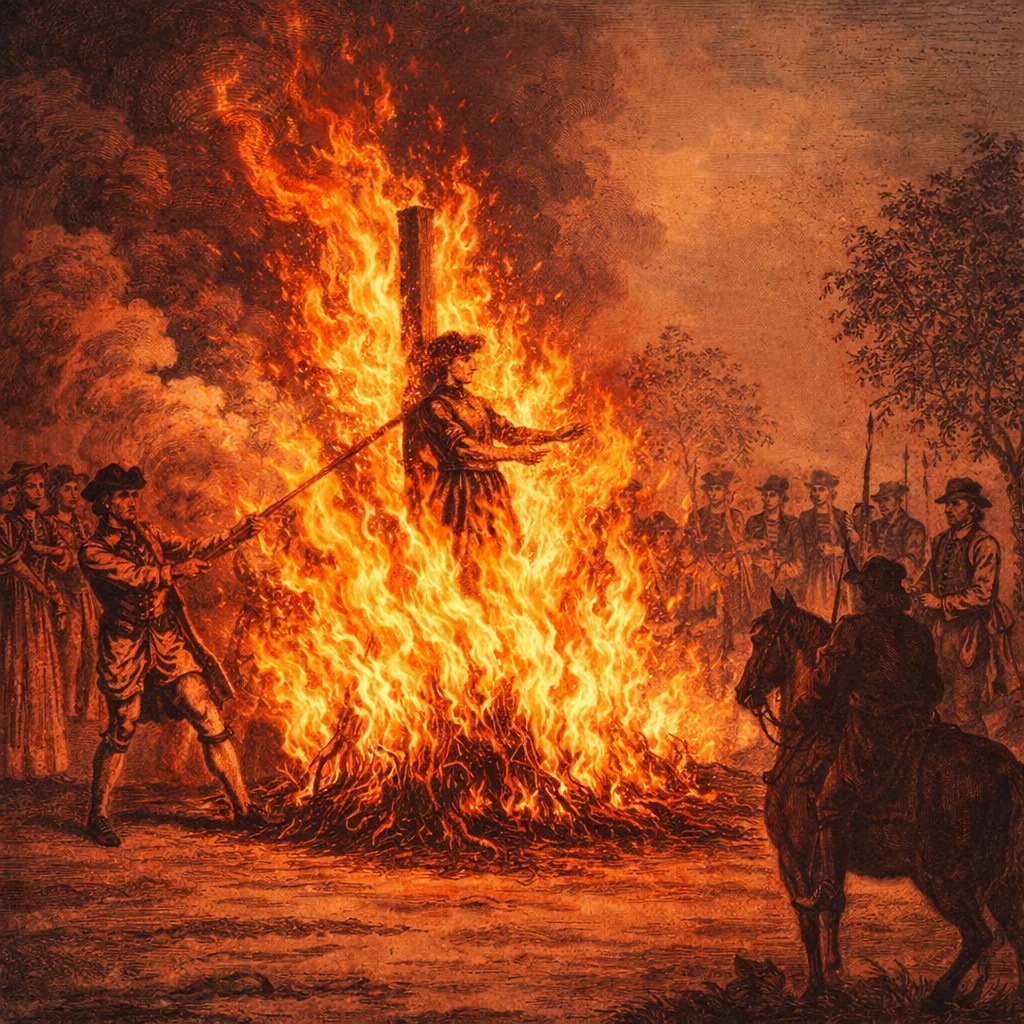
Burning at the Stake: used for heresy and for women convicted of treason or murdering their husband.
The True Legal Grounds for Burning Women
Historically, English law reserves burning at the stake for very specific offenses.
Petty Treason: Under English law, if a man killed his wife, it was considered standard murder. However, if a woman killed her husband, it was legally classified as petty treason. This is because a husband was viewed as the king of his household; killing him was an act of rebellion against the established social order. The mandated execution method for a woman convicted of petty treason was being burnt at the stake.
High Treason & Heresy: Women were also burnt for high treason (such as counterfeiting money or conspiring against the monarch) and religious heresy.
Early History of Burning in Britain
It is not known when burning was first used in Britain, but there is a recorded burning for heresy in 1222, when a deacon of the church was burnt at Oxford for embracing the Jewish faith so he could marry a Jew.
In 1401, the king authorised a Statute of Heresy which gave the clergy power to arrest and try those suspected of heresy. The first to suffer under the new act was one William Sautre, a priest, who was executed at (Kings) Lynn in 1402. This statute was repealed but, in 1553, burning was re-introduced by Henry VIII’s daughter, Mary Tudor (“Bloody Mary”).
During her five-year reign of terror (1553–1558), 274 burnings of both sexes for heresy were recorded. In most cases their only “crime” was following the Protestant faith. The normal place of execution in London being at West Smith Field (now called just Smithfield). An engraving of the period shows that these unfortunates were stood in empty tar barrels at the stake and then had faggots heaped round them. It was not the practice to strangle heretics before they were burnt so they died slow and horrible deaths – being literally burned alive.
There didn’t seem to be any need to write about Mary. It is enough to say that her reign is regarded as worse than the Spanish inquisition. Probably because she was a catholic there are no books and no movies about her. Nobody says of Mary “she was just a girl”.
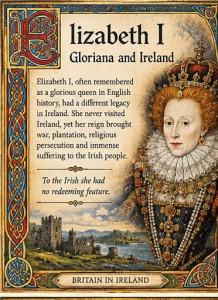 Check out Elizabeth I in greater detail
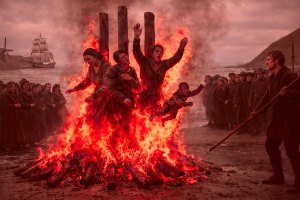
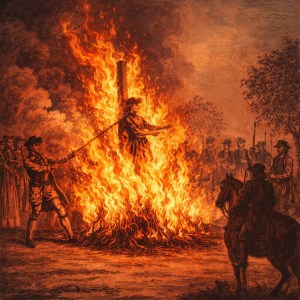
Check out the Guernsey Martyrs above
Peine Forte et Dure: accused persons who refused to plead were slowly crushed under weights until they complied or died.
Amazingly some people opted to be crushed to death, thus avoiding official conviction and meaning their children could still inherit their lands. Catholic martyr Margaret Clitherow died this way in 1586.
Boiling to Death: a Tudor punishment for poisoners.
A quick death would only come if the liquid was already boiling when the victim was dunked in. They might also be able to speed up the process if they ducked their head underneath the liquid to boil their brain. But otherwise, it was long and torturous until the very end.
Copy and paste: https://www.ladbible.com/news/worst-execution-tudor-history-richard-roose-978449-20240619
Corporal punishments were equally vicious. Public whippings flayed flesh until it bled, and branding marked the poor permanently as outcasts. Even into the 20th century, the cat‑o’-nine‑tails remained in use.

Public humiliation was treated as entertainment. In the pillory, crowds hurled filth, stones, and dead animals at the restrained victim. Women accused of gossiping were muzzled with the Scold’s Bridle, a metal cage with a spike forced into the mouth. Ducking Stools “Disorderly” women were repeatedly dunked in water this involved tying the victim to a chair and dunking her repeatedly into a river or pond.
The Bloody Code: When Theft Meant Death
By the 18th century, Britain had created one of the harshest legal systems in European history. Under the Bloody Code, more than 200 offences carried the death penalty — many shockingly minor. People were hanged for stealing a sheep, picking pockets, or taking goods worth just five shillings.
The Black Act of 1723 made it a capital crime to cut down trees or hunt deer in royal forests. Public executions became spectacles, complete with food stalls and crowds gathering at Tyburn as if attending a festival.
The Murder Act of 1752 added further terror: executed murderers could not be buried. Their bodies were dissected publicly or hung in chains until they rotted.
Eventually, the cruelty undermined the system itself. Juries refused to convict starving people for petty theft because they did not want to send them to the gallows.
Private whipping (in prison, with the press in attendance), from the 1850s, continued, however which authorised up to 50 strokes. This punishment was not abolished until 1948.
Cruelty Exported: The Empire’s Violence Abroad
Given this history, it is no surprise that Britain exported brutality wherever it colonized. In India, the empire adopted and perfected one of the most horrifying execution methods: blowing from a gun.
A prisoner was tied to a cannon, often with their back against the muzzle. When fired, “his head is seen to go straight up in the air some 40 or 50 feet… the arms fly off right and left… the legs drop to the ground beneath the muzzle of the gun and the body is literally blown away altogether.”
This method did more than kill. It deliberately prevented Hindu and Muslim funeral rites, extending punishment beyond death. The British used it extensively after the 1857 Rebellion; in one report from the Peshawar Valley, 44 rebels were executed this way in just a few months.
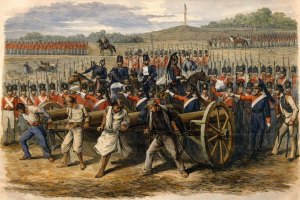
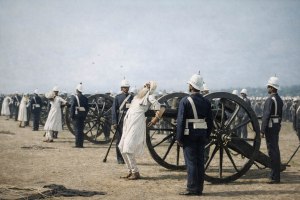
A Stark Contrast: Akbar’s Empire
Placed beside British rule, the Mughal emperor Akbar’s governance appears strikingly humane and sophisticated.
Akbar built a planned capital at Fatehpur Sikri, sponsored interfaith debates, welcomed Jesuit scholars, and maintained a vast multilingual library. He abolished the jizya tax on non‑Muslims, encouraged widow remarriage, discouraged child marriage, and outlawed sati. He integrated Hindu chiefs into high office and celebrated Hindu festivals himself.
His administrative reforms were equally advanced. With Raja Todar Mal, he created a revenue system based on local crop data and soil quality, ensuring taxes were tolerable for peasants while still profitable for the state.
By 1600, Akbar’s empire generated £17.5 million in revenue — more than Britain’s entire treasury two centuries later.

The Verdict
Britain claimed to bring civilisation to the world, yet its own justice system was built on terror, spectacle, and institutionalised cruelty. The empire carried these practices abroad, leaving scars that remain today.
In contrast, Akbar’s India demonstrated that power could be exercised through inclusion, reform, and intellectual openness a reminder that empire need not be synonymous with brutality.
How close did Britain come to exterminating the Irish race? Sir William Petty, in his Political Anatomy of Ireland estimates that during the Cromwellian Settlements the population had been reduced to 610,000. (Prendergast estimates that the population had been reduced by five-sixths.) They probably died more quickly in the years immediately after that estimation, when they were cooped up in Connacht west of the Shannon river, without houses, cattle, or implements of tillage – as it were, to live off the wind. Most estimates put the Irish population as having been reduced to around 500,000.
So many people have been brainwashed in the English-speaking world that it is difficult and sometimes impossible to overcome the brainwashing and indoctrination and the myths.
Myths and legends can be dangerous when they lead to misinformation. When people act on unverified beliefs, false assumptions, or inaccurate knowledge they become treacherous. Myths and legends can be perilous when they lead to misinformation. When people act on unverified beliefs, false assumptions, or inaccurate knowledge and believe in things that are basically made up they become very dangerous.
John Mitchel wrote in the opening of his Jail Journal, ‘England has been left in possession not only of the soil of Ireland – but in possession of the world’s ear also. She may pour into it what tale she will: and all mankind will believe it’. Nothing much has changed.
[As much use as possible has been made from information that already exists online and the insertion of some of my songs.]

Rebellions, uprisings, and outright revolution against British authority took place throughout the life of the empire, and were put down harshly. During many of these revolts, the British dealt with natives in terms which were often unbelievably cruel, rivalling the worst atrocities of the Romans before them, and the Nazis after.
In 2012 the British Foreign Office admitted that thousands of records documenting atrocities committed by the British Army and colonial service were deliberately destroyed, and the records which remained were illegally kept hidden from the eyes of the media and the public.
Add to its longevity and unrivalled global footprint, and the British Empire’s baneful legacy may well have been deeper and more diffuse than that of any other modern state. Was British liberal imperialism, given the extent of the damage it inflicted over generations, a more malevolent influence on world history than Nazi Fascism?
In Ireland as elsewhere the British had a simple objective: to amass a fortune quickly.
The countries in the partial list below have the British Empire’s brutality as part of their past.
Aden (Yemen)
Ascension Island
Anguilla
Australia
America
Bahamas
Bahrain
Barbados
Basutoland (Lesotho)
Bechuanaland (Botswana)
Bermuda
British Cameroon
British Guyana (Guyana)
British Honduras (Belize)
British Somaliland (Somalia)
British Solomon Islands
Brunei
Burma (Myanmar)
Canada
Cayman Islands
Ceylon (Sri Lanka)
China
Cook Islands
Cyprus
Falkland Islands and dependencies
Egypt
Fiji
Gambia
Gibraltar
Gilbert and Ellice Islands (Kiribati & Tuvalu)
Gold Coast (Ghana)
Grenada
Hong Kong
India (included Pakistan & Bangladesh)
Iraq
Ireland
Jamaica
Kenya
Kuwait
Malaya (West Malaysia)
Maldive Islands
Malta
Mauritius
Montserrat
Newfoundland (Canada)
New Hebrides (with France) Vanuatu
New Zealand
North Borneo (Sabah)
Nyasaland (Malawi)
Oman
Papua New Guinea
Palestine (Falestin/Israel)
Pitcairn Island
Qatar
Rhodesia (Zimbabwe and Zambia)
Sarawak (East Malaysia)
St Helena
St Kitts
St Lucia
St Vincent
Seychelles
South Africa
Swaziland
Tanganyika (Tanzania)
Tonga
Transjordan (Jordan)
Trinidad
Tristan Da Cunha
Trucial Oman (United Arab Emirates)
Turks and Caicos Islands
Uganda
Western Samoa
Zanzibar (Tanzania)
All these countries were raided and pillaged but the main focus will be on Ireland and India.
Ireland because the genocide was nearly completed more than once and the failure wasn’t for lack of trying.
The history of the African slave trade into the America’s is one that is well-documented as well as largely taught in American schools today.
John Martin of the Montreal-based Centre for Research and Globalization points out in his article ‘The Irish Slave Trade – The Forgotten ‘White’ Slaves,’ it was not just Africans who were traded as slaves.
Strangely though, the history of Irish and ‘white’ slavery is by and large ignored in the American educational curriculum today.
In his article, John Martin writes:
The Irish slave trade began when James II sold 30,000 Irish prisoners as slaves to the New World. His Proclamation of 1625 required Irish political prisoners be sent overseas and sold to English settlers in the West Indies. By the mid-1600s, the Irish were the main slaves sold to Antigua and Montserrat. At that time, 70 percent of the total population of Montserrat were Irish slaves.
Ireland quickly became the biggest source of human livestock for English merchants. The majority of the early slaves to the New World were actually white.
Martin writes how at the hands of the British, the Irish population plummeted due to the slave trade of the 17th century.
During the 1650s, over 100,000 Irish children between the ages of 10 and 14 were taken from their parents and sold as slaves in the West Indies, Virginia and New England. In this decade, 52,000 Irish (mostly women and children) were sold to Barbados and Virginia. Another 30,000 Irish men and women were also transported and sold to the highest bidder. In 1656, [Oliver] Cromwell ordered that 2000 Irish children be taken to Jamaica and sold as slaves to English settlers.
Martin goes on to explain that for some reason, the Irish slaves are often remembered as ‘indentured servants.’ However, in most cases during the 17th and 18th centuries, they were no more than “human cattle.”
“…the African slave trade was just beginning during this same period,” writes Martin. “It is well recorded that African slaves, not tainted with the stain of the hated Catholic theology and more expensive to purchase, were often treated far better than their Irish counterparts.”
During the late 1600s, writes Martin, African slaves were far more expensive than their Irish counterparts – Africans would sell for around 50 pounds sterling; while Irish were often no more than 5 pounds sterling.
Further, the treatment of Irish slaves was thought to be crueller than that of African slaves. If an Irish slave was beaten by their owner, it wasn’t considered to be a crime.
The Irish were further exploited when the British began to “breed” Irish women – or girls, sometimes as young as 12 – with African males.
These new “mulatto” slaves brought a higher price than Irish livestock and, likewise, enabled the settlers to save money rather than purchase new African slaves. This practice of interbreeding Irish females with African men went on for several decades and was so widespread that, in 1681, legislation was passed “forbidding the practice of mating Irish slave women to African slave men for the purpose of producing slaves for sale.” In short, it was stopped only because it interfered with the profits of a large slave transport company.
Even when they were not slaves they were treated worse than slaves. In 1855, Frederic Law Olmsted, the landscape architect who designed New York’s Central Park, was in Alabama for the collection of stories he was writing called ‘A Journey in the Seaboard Slave States; With Remarks on Their Economy’ and saw bales of cotton being thrown from a considerable height into a cargo ship’s hold. The men tossing the bales somewhat recklessly into the hold were Negroes; the men in the hold were Irish.
The mate, standing near the bottom of the slide, as soon as the men had removed one bale to what he thought a safe distance, would shout to those aloft, and down would come another. Not unfrequently, a bale would not strike fairly on its end, and would rebound off, diagonally, overboard; or would be thrown up with such force as to go over the barricade, breaking stanchions and railings, and scattering the passengers on the berth deck. Negro hands were sent to the top of the bank, to roll the bales to the side, and Irishmen were kept below to remove them, and stow them. On asking the mate (with some surmisings) the reason of this arrangement, he said.
‘Oh,’ said the worker, ‘the niggers are worth too much to be risked here; if the Paddies are knocked overboard or get their backs broke, nobody loses anything.’
Whites were auctioned on the block with children sold and separated from their parents and wives sold and separated from their husbands.
India is focused on because it was considered the “Jewel in the Crown” (or the jewel in the imperial crown) and it accurately describes India’s position in the British Empire. As Britain’s most valuable and populated colony, it served as the economic engine and strategic anchor of global British imperialism.
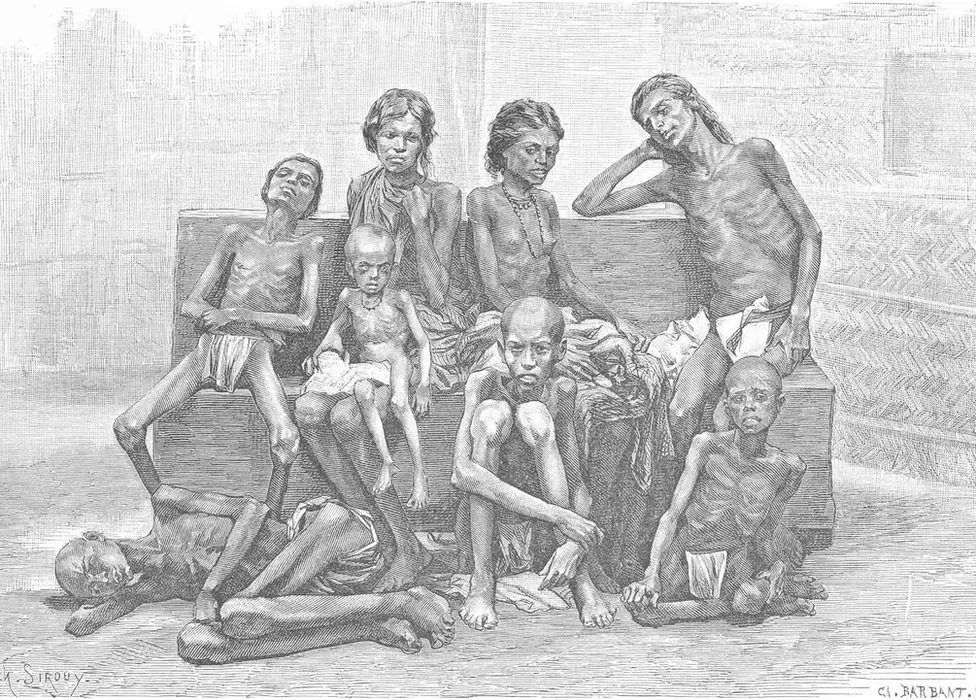
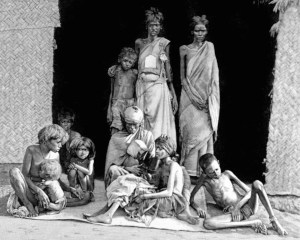
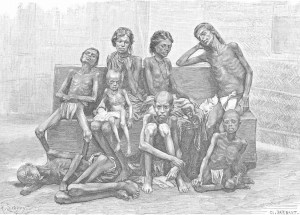
The British deliberately caused famine in Ireland and India.
The Bengal Famine of 1943 was a devastating, man-made catastrophe in British India that killed up to 3 million people. Triggered by harsh colonial policies, it remains one of the worst civilian disasters in modern history.
Churchill-era British policies diverted grain, shipping, and resources to support the war in Europe and the Middle East, ignoring urgent appeals from Indian viceroys for relief. British authorities stockpiled food to feed defending troops, and they exported considerable quantities to British forces in the Middle East. They also confiscated boats, carts, and elephants in Chittagong, where the invasion was expected. This deprived fishermen and their customers of the ability to operate and generally inhibited the sort of low-level commerce upon which many Bengalis relied for survival.
Not only did they starve the Indians, the British military bombed parts of India during World War II. In August 1942, to suppress the massive anti-colonial Quit India Movement, the British colonial administration deployed Royal Air Force (RAF) planes to fire upon and drop bombs on protesting crowds and villages in several provinces, including Bihar and Bengal.
India provided vast resources, including raw materials like cotton, indigo, silk, and spices. It was a massive market for British manufactured goods and generated immense tax revenue.
The British Indian Army was a massive, inexpensive military force used to expand and defend British interests across Asia and the Middle East, including fighting in both World Wars.
Controlling India gave Britain dominance over vital trade routes to the East and allowed for the further expansion of imperial territories.
After the British lost their North American colonies in the American Revolution, they refocused on India with a desire to make it their most profitable overseas colony. By the mid-nineteenth century, India was responsible for much of Great Britain’s wealth.
India quickly proved to be a lucrative territory. Cotton, timber, tea, minerals, ivory, and actual jewels from India were brought to Great Britain in massive quantities.
Opium grown in India was sold by the British in China, bringing further wealth to Britain.
They stole tea plants from China to grow in India for a much cheaper price.
India already had a type of tea, growing wild and cultivated for medicinal use. But the British didn’t want that; they wanted the tea from China, but for far less than what the Chinese charged them. They started plantations in Assam, awaiting the tea seeds and plants from China.
How A Scottish Botanist Stole the Secrets of Tea from China
[The British did this in the name of free trade and without regard to the consequences for the Chinese government and Chinese people. The lesson that the Chinese learn today about the Opium Wars is that China should never again let itself become weak, ‘backward,’ and vulnerable to other countries.]
Because of its very large population, there was no shortage of workers and farmers in India to serve the needs of the British.
Furthermore, the literal jewels in the English crown come from India. Many of the gemstones and diamonds in these actual crowns came from mines in the subcontinent. While this is not the reason India earned this particular moniker, it helps to drive home the point of how the British took advantage of the wealth of India.
The Koh-i-Noor (meaning “Mountain of Light” in Persian) is a historic, oval-cut, 105.6-carat diamond. Mined in India, it passed between various empires before being annexed by the British in 1849. Today, it remains part of the British Crown Jewels and is actively claimed by several nations.
Following the Second Anglo-Sikh War, the British forced the 11-year-old Maharaja Duleep Singh to surrender the diamond to Queen Victoria as part of the 1849 Treaty of Lahore.
Historian Andrew Roberts told the ‘Mail on Sunday’: “Those involved in this ludicrous case should recognize that the British Crown Jewels is precisely the right place for the Koh-i-Noor diamond to reside, in grateful recognition for over three centuries of British involvement in India, which led to the modernisation, development, protection, agrarian advance, linguistic unification and ultimately the democratisation of the sub-continent.”
He probably knows the truth but he knows that the readers don’t want to know the truth, so he writes what they want to hear.
If he is a historian he should know the truth. If he doesn’t know the truth then he is not a historian just another propagandist.
Niall Ferguson is another propogandist “nostalgist for empire” who holds notably positive views concerning the history of the British Empire and American imperialism. He argues that these empires often provided necessary institutional stability, global trade networks, and the rule of law.
Ferguson’s claim that Britain “made the modern world” by spreading democracy, free trade, capitalism, the rule of law, Protestantism, and the English language. He never explains precisely how this was done.
But you can’t wake up someone who is pretending to be asleep.
As is often the case when a terrible social injustice is done to one or several generations of a people, the succeeding generations may actually benefit from the terrible wrong and the suffering of their ancestors. But that does not in any way excuse or mitigate the crimes against those ancestors, or turn the perpetrators of those crimes into benign social engineers.
But while the propaganda machine allows the British to live in their self-righteous cocoon, they cannot understand the ingratitude of the world. While genocidal maniacs like Hitler, Stalin, Pol Pot, Sadam Husain and Idi-Amen are well known, any of the monarchs of Britain, ‘despot under the forms of law’, from Henry VIII (and before) down to Queen Victoria could have held their own with the best of them.
There is a common deception held by most British people that their former empire was a benevolent servant of mankind, whereas Britain’s imperial conquests manifestly have not even been in the interest of the ordinary British people.
The apologists would do well to ponder the words of the great British writer William Makepiece Thackeray who characterized British colonialism in Ireland as follows:
It is a frightful document against ourselves…one of the most melancholy stories in the whole world of insolence, rapine, brutal, endless slaughter and persecution on the part of the English master…. There is no crime ever invented by eastern or western barbarians, no torture or Roman persecution or Spanish Inquisition, no tyranny of Nero or Alva but can be matched in the history of England in Ireland.
The English talk a lot about political morality. They established a world empire, because they had superior weaponry, at a time when politics was not all that concerned about morality. Then they turned moralistic. They are experts at the art of hiding their misdeeds behind a facade of virtue. They even convince themselves that they are the exemplars of political virtue.
They forget that there was a difference between the interests of the British Empire and those of its subject peoples. They write of British investments in ‘railways and port facilities’ and ‘plantations to produce crops’ as if they seized the land then exploited the labour and exported the wealth of the colonies for the benefit of the natives. They talk of bringing knowledge and culture to the colonies but forget that they destroyed the institutions, knowledge and culture of the colonized, and thus the very foundation of their society.
But as they sow so shall they reap.
The process of colonial rule in India meant economic exploitation and ruin to millions, the destruction of thriving industries, the systematic denial of opportunities to compete, the elimination of indigenous institutions of governance, the transformation of lifestyles and patterns of living that had flourished since time immemorial, and the obliteration of the most precious possessions of the colonised, their identities and their self-respect.
In 1600, when the East India Company was established, Britain was producing just 1.8% of the world’s GDP, while India was generating some 23% (27% by 1700). By 1940, after nearly two centuries of the Raj, Britain accounted for nearly 10% of world GDP, while India had been reduced to a poor “third-world” country, destitute and starving, a global poster child of poverty and famine. The British left a society with 16% literacy, a life expectancy of 27, practically no domestic industry and over 90% living below what today we would call the poverty line.
The India the British entered was a wealthy, thriving and commercialising society: that was why the East India Company was interested in it in the first place. Far from being backward or underdeveloped, pre-colonial India exported high quality manufactured goods much sought after by Britain’s fashionable society. The British elite wore Indian linen and silks, decorated their homes with Indian chintz and decorative textiles, and craved Indian spices and seasonings. In the 17th and 18th centuries, British shopkeepers tried to pass off shoddy English-made textiles as Indian in order to charge higher prices for them.
If there were positive by-products for Indians from the institutions the British established and ran in India in their own interests, they were never intended to benefit Indians. Today Indians cannot live without the railways but they remain only because the British couldn’t take them with them. Industrial Revolution and Railways in England were finance by profits of East India Company, so Railways were India’s ‘gift’ to England.

There is a positive note to end after so much sadness.
According to Wikipedia:
Ireland has a highly developed knowledge economy, focused on services in high-tech, life sciences, financial services and agribusiness, including agrifood. Ireland is an open economy (3rd on the Index of Economic Freedom), and ranks first for high-value foreign direct investment (FDI) flows. In the global GDP per capita tables, Ireland ranks 2nd of 192 in the IMF table and 4th of 187 in the World Bank ranking.
And also from Wikipedia:
India is the world’s sixth-largest economy by nominal GDP and the third-largest by purchasing power parity (PPP) as of April 2026. The Indian economy was the largest and most prosperous throughout world history and would continue to be under the Mughal Empire, up until the 18th century. Sean Harkin estimates that China and India may have accounted for 60 to 70 percent of world GDP in the 17th century

How the British used Railways to Destroy Colonial India