
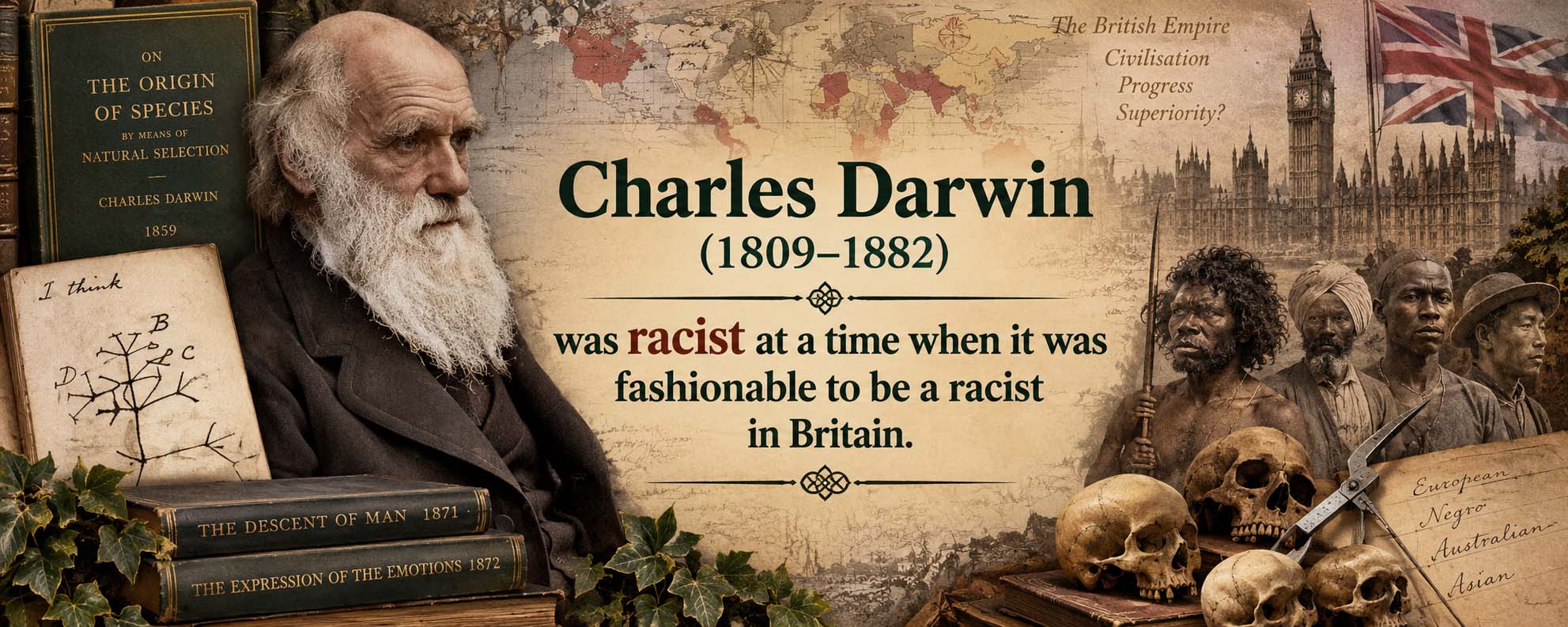
Charles Darwin
Charles Darwin (1809–1882) was racist at a time when it was fashionable to be a racist in Britain.
Darwin’s ideas arrived at the perfect moment for a self‑assured British Empire. Empire shaped Darwin, and Darwin repaid the favour by giving colonial racism a scientific gloss.
He extended the “fight for survival” to human societies, arguing that races came from different origins and they were locked in a struggle where “superior races would survive” and the rest would fade into history. This logic even framed genocide as mercy; the state should “smooth the pillow of the dying race.”
Darwin was lampooned and babooned especially in magazines but such thinking thrilled the Anglo‑Israelite Puritans, who already believed they were God’s chosen people. Darwin reinforced their fantasies. He wrote that the “careless, squalid, unaspiring Irishman multiplies like rabbits,” and claimed that even if Celts became the majority, “five-sixths of the property, of the power, of the intellect would belong” to the remaining Saxons.
Social scientists embraced this hierarchy. As Lalita Vidyarthi noted, by the late 1800s racism was treated as scientific fact. Darwin’s framing of humans as animals locked in a brutal contest legitimized violence and cruelty.
Yet evolution doesn’t preserve individuals, it preserves traits. Darwin’s worldview reflected his own English upbringing: the prejudices, class assumptions, and imperial confidence of a man who believed his culture sat atop the evolutionary ladder.
Real people do science and Darwin was a real Englishman. He had the cultural background of an Englishman the bias and prejudices of an Englishman, the outlook of an Englishman and he was influenced by other Englishmen. As an Englishman he already occupied the moral high ground by right of birth.
Most human beings did not just appear at the top of the evolutionary ladder to reap the benefits of millions of years of evolution without having to live through it. But Englishmen did. All of these formed his views and his views appealed to the many self-centred, narcissistic, competitive, confident and individualistic Englishmen.
The culture of the English colonists already had formed Darwin’s theory for him in their contact with the American Indian, the African continent, the people of Asia in general, the Australian Aboriginal and of course the Irish, ‘The Missing Link’.
The phrase “the Irish as the missing link” stems from a dark era of 19th-century pseudoscientific racism and Victorian propaganda. Propagated by prejudiced cartoonists and eugenicists like John Beddoe, the theory falsely depicted the Irish as an evolutionary “missing link” between apes and Anglo-Saxons to justify political subjugation and racial discrimination.
Charles Kingsley, a disciple of Darwin’s, writing after witnessing famine‑induced destitution in Ireland, described the people he saw as ‘human chimpanzees’, yet insisted they were ‘better and more comfortably fed and lodged under our rule than they ever were.’ His words reveal the moral blindness of Victorian imperial thought: pity twisted into justification.
A gaze cast across a starving land, calling suffering ‘progress.’ In the mist between witness and truth, the blindness of empire lingers.
Darwin read An Essay on the Principle of Population, published in 1798, by former professor of political economy Thomas Malthus the cleft-palated reverend, the ‘malicious mediocrity’ according to Tolstoy. It was from him that the theory of the ‘survival of the fittest’ came to Darwin. It is not the message of evolution that is the shortcoming of Darwin’s misguided followers it is their adherence to the ‘survival of the fittest’ doctrine and its cruel connotations. There was, Malthus argued, a built-in agony to human existence, in that the growth of a population will always outrun its ability to feed itself.
In his best-known work, Essay, Malthus suggested that streets should be made narrower and more people crowded into houses, to encourage the return of the plague. Villages should be built next to stagnant pools and, above all, remedies for preventing and curing disease ought to be strongly condemned, he said:
To this end, I should propose a regulation be made declaring that no child born… should ever be entitled to parish assistance… The [illegitimate] infant is comparatively speaking, of little value to society, as others will immediately supply its place… All children beyond what would be required to keep up the population to this [desired] level, must necessarily perish, unless room be made for them by the deaths of grown persons.
From such a mind did the idea of the ‘survival of the fittest’ emerge, and it has dominated ‘science’ ever since! Add to this the belief that the intellect of a person is genetically determined by the intellect of the parents and you have the eugenics movement, which came to the surface so infamously under the rule of Adolph Hitler.
Malthus’s ideas, mostly plagiarised from Venetian Giammaria Ortes’s published works, were widely accepted. European upper-class intellectuals in particular supported his pitiless ideas. And no wonder, the upper class didn’t have to die off, only the hoi polloi. Even one hundred years later, in an article titled The Nazis’ Secret Scientific Agenda, the importance of Malthus’s views on population is described:
Instead of recommending cleanliness to the poor, we should encourage contrary habits. In our towns we should make the streets narrower, crowd more people into the houses, and court the return of the plague. In the country we should build our villages near stagnant pools, and particularly encourage settlements in all marshy and unwholesome situations.
And so forth and so on.
As a result, those who lost the struggle for survival would be eliminated, and the rise in population would be stabilized. The ‘struggle for survival’ demanded by Malthus’s theory led millions to an early death. (Malthus’s theory did not explain how if the fittest continued to become fitter and better producers of offspring the population would decrease?) Those who may have felt guilty were vindicated by Darwin’s new religious dogma and his adaptation of ‘the survival of the fittest’ premise.
From these ideas emerged eugenics. Francis Galton, Darwin’s cousin, called for forced sterilization of the “unfit.” The upper classes embraced such theories because they targeted the poor, not themselves.
The term ‘fittest’ had a nice ring to it whereas it really meant the survival of the meanest, nastiest, cruellest, most evil and most vindictive.
Darwin, showing some empathy, wrote to his friend the botanist Joseph Hooker, that his belief was ‘like confessing a murder.’
Darwin’s “struggle for existence” became a moral shield for brutality. It justified starvation, exploitation, and eventually the racial ideologies that fed into Hitler’s worldview. Hitler proclaimed that “a higher race subjects to itself a lower race… a right which we see in nature.”
Darwin also ignored the vast evidence of altruism in nature, from vervet monkeys giving alarm calls to walruses adopting orphans, because it didn’t fit his narrative. It was a puzzle but it stood opposed to the fundamentals of Darwin’s theory so he chose to ignore it.
Had Darwin been more brilliant, he would not have been taken so seriously. Had he dug more deeply he would not have been understood. Had he known more he would not have understood it himself. His very limitation and simplicity made him and his theory a widespread religious success.
Harvard Professor Ernst Mayr, for example, stated that the thinking behind The Origin was ‘bewildered’, ‘hopelessly confused’, and even went so far as to say that it showed a ‘lack of understanding of the nature of species!
Was Darwin even necessary? Would evolution have been understood without him? Long before Darwin there was Jean-Baptiste Lamarck (1744-1829) a Frenchman who beginning in 1801 began to publish details of his evolutionary theories. In 1801 he wrote:
. . . time and favourable conditions are the two principal means which nature has employed in giving existence to all her productions.
Although he died in poverty and his grave is unmarked and unknown, and he knew nothing about genes, he was closer to describing such things as epigenetics (the study of how your behaviours and environment can cause changes that affect how your genes work) than anybody else for another 150 years.
What if there never was a Darwin or a Malthus or Thomas Huxley? According to Darwin and his colleagues, altruism acting in a way that benefits others, even at the expense of yourself, did not exist although he knew that it did.
Darwin’s theories could never explain them.
Whose theories could?
If instead of Darwin and his colleagues we had the Russian scientists instead. We would have those such as Nikolai Danilevsky and Prince Peter Kropotkin, and others, with very different values. George Price the strange, sad, and brilliant thinker showed that as a whole altruism contributes to the individual development of an organism within a species from a mathematical point of view.
Oren Harman in The Price of Altruism: the story of George Price and the Search for the Origins of Kindness, says that Danilevsky saw Darwin’s dependence on Malthus as proof of the inseparability of science from cultural values. He wrote that, ‘The English national type accepts [struggle] with all its consequences, demands it as his right, tolerates no limits upon it.’ Darwinism was ‘a purely English doctrine’.
Thirty years after Charles Darwin set sail on the Beagle Prince Peter Kropotkin set out to find evidence for Darwin’s great theory. He had read The Origin of Species and what he saw came as a great surprise: Darwin spoke of a fierce struggle between members of the same species, but everywhere he looked Kropotkin found collaboration.
Mutual aid and cooperation were everywhere. After five years of adventure – the same amount of time as Darwin – Kropotkin’s declaration of the struggle for existence was shattered. He found that ‘natural selection continually seeks out the ways precisely for avoiding competition.’ He was to write about altruism, in what would become famously known in 1902 as the book Mutual Aid:
If the man who gives away his last shirt found no pleasure in doing so, he would not do it. If he found pleasure in taking bread from a child, he would do that but this is distasteful to him. He finds pleasure in giving, and so he gives.
Wherever I saw animal life in abundance, I saw Mutual Aid and Mutual Support.
…It is not love to my neighbour – whom I often do not know at all which induces me to seize a pail of water and to rush towards his house when I see it on lire; it is a far wider, even though more vague feeling or instinct of human solidarity and sociability which moves me. So it is also with animals.
The lesson was:
‘Don’t compete! Competition is always injurious to the species, and you have plenty of resources to avoid it. ….Therefore combine – practice mutual aid! That is the surest means of giving to each other and to all the greatest safety, the best guarantee of existence and progress, bodily, intellectual, and moral.
Even prominent scientists later criticized Darwin’s work as confused, opportunistic, or scientifically thin. Yet his simple, brutal message spread easily because it suited the powerful.
Hitler, who emerged with Darwin’s views, cost another fifty-five million lives and filled Europe’s fields with blood.
Indeed, Darwin’s ideology was used by the propagandists all the way to WWII and beyond. In the 1933 Nuremberg party rally, Hitler proclaimed that ‘a higher race subjects to itself a lower race… a right which we see in nature and which can be regarded as the sole conceivable right’.
The historian Hickman describes Darwinism’s influence on Hitler:
(Hitler) was a firm believer and preacher of evolution. Whatever the deeper, profound, complexities of his psychosis, it is certain that [the concept of struggle was important because] … his book, Mein Kampf, clearly set forth a number of evolutionary ideas, particularly those emphasizing struggle, survival of the fittest and the extermination of the weak to produce a better society.
Of course, the British ruling class decried and derided these ‘struggle for survival’ philosophies in the Nazi party’s dogma, although they had served them well over the centuries of their own colonial conquest.