Welcome to this page, and thank you for visiting. Here you’ll find background information about the songs, lyrics, recordings, and creative processes behind the music on this website.
My name is Martin McMahon, and this collection represents a lifetime of writing, remembering, and reconnecting with music across continents and decades.

ABOUT THE SONGS
All songs, tunes, and lyrics on this website were written by me unless otherwise noted.
I sing only a few of the tracks myself:
“The Croppy”, Veronica’s gone Home and “Piggy and the Constable (Jig)”. As well there is “The Famine” which is a recitation with some singing.
The remaining songs were originally recorded by me on various CDs. For the versions you hear here, I used an AI singing‑voice generator. I recorded the vocals myself and then used Controller Voice to transform them into a more polished, professional sound.
If you listen to “The Croppy”, you may notice a frequency issue. This often happens when many instruments and layers are added to a track, muddy low‑end, harsh highs, or general clutter. A live band would naturally resolve some of these challenges. But I don’t have one.
Around thirty percent of my songs required a female voice, and the AI female voice proved ideal for those pieces.
ETHNA CARBERRY — LYRIC CONTRIBUTIONS
My favourite poet. Eight of the songs on this site use her lyrics:
- The Passing of the Gael
• The Well
• In Tír‑na’n‑Óg
• A Glen Song
• Do You Remember Yet
• I Hold Your Hand in Mine
• The Cold Sleep of Brighidin
• What Go Ye Seeking
Her writing has always resonated deeply with me, and it has been an honour to set her words to music.
- B. YEATS — LYRIC CONTRIBUTIONS
Two songs on this site use lyrics by W. B. Yeats:
- The Song of Wandering Aengus
• When You Are Old These poems carry a timeless musicality that made them a natural fit for melody.
Amelia Blanford Edwards was a child during the height of the Irish Famine (1845–1852), which is the context for her poem “Give me three grains of corn” The poem was written during the famine period, likely when she was in her early to mid-teens.
Other Sources & Collaborations
- “The Irish Pub Song” – written with Robbie Dunn around the year 2000.
• “The Croppy” – originally a school poem in Irish by Douglas Hyde. The English translation is mine.
• “Meagher in Clonmel Jail” – verses written by Thomas Francis Meagher in 1848 while awaiting trial.
• “A Prayer for Me” – written in collaboration with Enda Haran of Ennistymon. We have never met; all communication has been by email. He has influenced other songs as well.

EARLY SONGWRITING
Some songs on this site were written when I was a teenager. Sadly, I did not bring my notebook of lyrics when I emigrated from Ireland, and many early songs were lost.
The ones I remember include:
• Oh Yes You Try
• Veronica’s Gone Home
• The Banks of Willow Creek
• As the Train Moves Out
• You Were Mine for a Little While
The rest — and there were many — are gone forever.
As a teenager, I sent some songs to the Donnie Collins Showband from Limerick, who were due to play at Lahinch Dance Hall. They contacted me through a third party, but I never managed to meet them. Rural houses had no phones in those days.

A MEMORY FROM HOME
I remember recording “Oh Yes You Try” with Paddy Neylon and Johnny Kinnane at the home of my uncle Mikie Hogan in Clooneyogan, while he was staying with our family in Callura. I had a battery‑powered reel‑to‑reel tape recorder and a microphone. To create echo, we placed a 15‑gallon (56‑litre) creamery can on the kitchen table and put the microphone inside it. We thought we were very advanced.
I played guitar, Johnny had a mouth organ, and Paddy played a homemade bodhrán with a plastic head instead of skin. We made what we believed was a reasonable sound.
RETURNING TO MUSIC
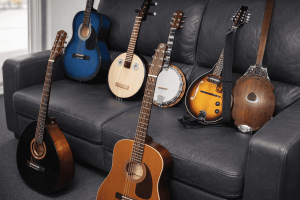
When I came to Australia, I didn’t play or sing for more than twenty years. One day I saw a tenor banjo in the window of a second‑hand shop, bought it, and began playing again. From there I rebuilt my skills, added more instruments, and played with musicians whenever the opportunity arose.